For most of the twentieth century, Saudi Arabia’s economic story was simple. Oil came out of the ground, money came in, and that was more or less that. The kingdom sat on the world’s second largest proven oil reserves and had little reason to think beyond them. For decades, that arrangement worked well enough. Then the people running the country started asking a question that made a lot of sense: what happens when the oil runs out, or when the world stops needing it?
The answer they came up with is Vision 2030, and what is happening to the Saudi economy right now is largely the story of that plan playing out in real time.
What the Numbers Show
Saudi Arabia’s economy expanded 4.5 percent in 2025, which is a solid number by any measure, and especially solid given how much global uncertainty there was through the year. The fourth quarter came in even stronger at 5 percent growth. The World Bank ranks Saudi Arabia as the world’s 19th largest economy, with a nominal GDP of around $1.3 trillion. These are not numbers that suggest a country in trouble. They suggest a country that is building momentum.
But the more interesting part is not the total growth. It is where the growth came from. Non-oil sectors grew 4.9 percent and now make up more than half the economy for the first time ever. Non-oil exports hit a record $25.9 billion in the final quarter of 2025, which is 114 percent higher than when Saudi Arabia first started tracking that number back in 2017. The link between oil prices and the health of the whole economy is still there, but it is not what it used to be.
What Vision 2030 Actually Is
Mohammed bin Salman announced Vision 2030 in 2016 and the idea behind it was straightforward even if the execution was not. Saudi Arabia needed an economy that could survive without oil, so it set about building one. Tourism, entertainment, technology, manufacturing, finance, renewables. Things that barely existed a decade ago are now being built at serious scale.
Some of it has already delivered. The digital economy is now 16 percent of GDP. Renewable energy capacity has tripled since 2022. Foreign investment hit $6.64 billion in just the third quarter of 2025, up 34.5 percent year on year. Unemployment among Saudi nationals dropped to 7 percent in 2024, which was the original 2030 target, hit early. Female unemployment has been cut in half in four years, and that is as much a social change as an economic one.
The Oil Question
Oil is not going anywhere. It grew 5.7 percent in 2025 and crude petroleum is still the single biggest part of the economy. Saudi Arabia pumped around 9 million barrels a day through much of the year and remains one of the most consequential players in global energy. When OPEC+ cuts started unwinding in May 2025, output went back up almost immediately.
The shift is not about replacing oil. It is about not being completely at its mercy. A bad year for oil prices used to mean a bad year for everything. That is becoming less true, slowly but visibly.
What Is Still Being Built
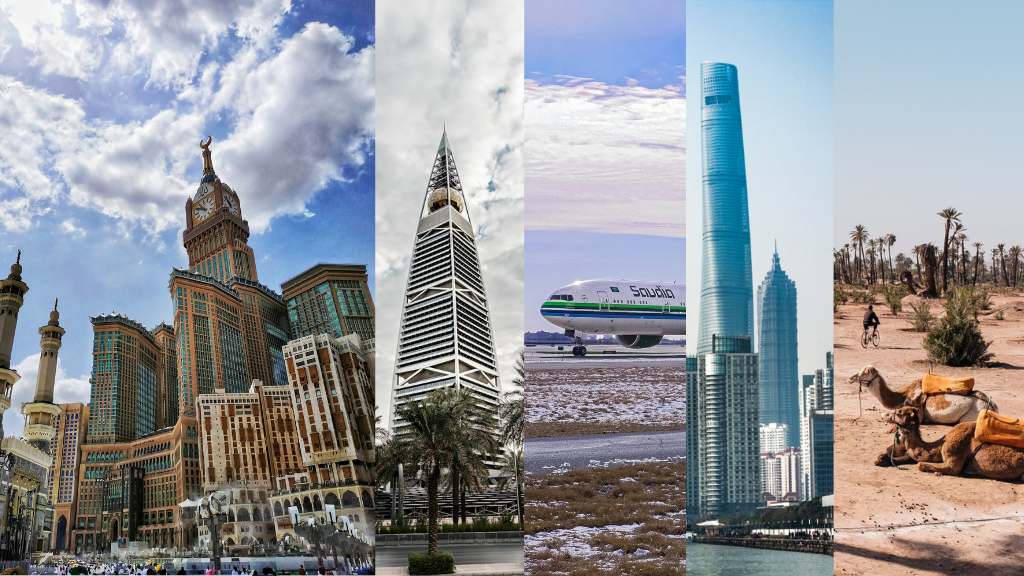
The projects underway right now are hard to get a handle on from the outside. NEOM sits in the northwest desert, a city being built from nothing that attracts attention partly for its ambition and partly because nobody is entirely sure how it ends. Entertainment and hospitality grew 6.2 percent in 2025, the strongest non-oil number of any sector, which reflects just how much daily life in the kingdom has changed. Concerts, sporting events, restaurants, things that were not part of the picture here not long ago are now part of the economy in a real way.
Religious tourism is growing too. Over 1.67 million pilgrims came for Hajj in 2025 and the government is chasing 30 million religious visitors a year by 2030. Getting there means expanding airports, hotels, roads, and digital systems all at once, and that work is still ongoing.
The Honest Picture
The transformation is real. The numbers back it up and the changes on the ground are visible to anyone who has spent time in the country recently. But it is still a work in progress and Saudi Arabia would be the first to say so. The economy still responds when oil moves, even if less dramatically than before. Some of the headline projects are expensive and have uncertain delivery dates. Building a private sector that genuinely runs on its own without the government pushing it along is hard, and plenty of countries have tried and fallen short.
Saudi Arabia has deep pockets and a leadership that is clearly in a hurry. That alone gets you further than most. Will every project come together the way it was planned? Probably not. These things never do. But something real is happening there and the numbers show it. Ten years ago this was a different country. Ten years from now it will probably be different again.