




Pakistan’s Nuclear Program History: The Complete Story
Pakistan’s nuclear program history is one of those things every Pakistani assumes they understand. We grew up hearing the same few stories. Bhutto and his grass quote. A.Q. Khan being called the father of the bomb. Chagai in 1998. That’s pretty much the version most of us carry around.
Pakistan’s nuclear program history is one of those things every Pakistani assumes they understand. We grew up hearing the same few stories. Bhutto and his grass quote. A.Q. Khan being called the father of the bomb. Chagai in 1998. That’s pretty much the version most of us carry around.
The actual history is way more interesting and a lot weirder. It involves serious scientific brilliance from people whose names most Pakistanis can’t even remember. It involves a national humiliation in 1971 that basically forced the country into a 26-year obsession. It involves stolen designs from a European nuclear facility. It involves the CIA helping us indirectly by pretending not to see what we were doing during the Afghan war. And it involves the moment in May 1998 when we finally stopped pretending we didn’t have the bomb and tested six of them in front of the world.
Some of this is glorious. Some of it is genuinely uncomfortable. A lot of it doesn’t match the patriotic story we tell ourselves in school. But it’s how it actually happened.
This is the real version. How Pakistan actually got nuclear weapons, with the parts the textbooks skip and the nuance the highlights reel misses.
The Peaceful Beginning
Here’s something that surprises people. Pakistan’s nuclear program started off completely peaceful. No weapons agenda at all in the beginning.
PAEC (Pakistan Atomic Energy Commission) got set up in 1956. Just nuclear research, medical stuff, maybe electricity generation eventually. Pretty standard developing country science program.
Dr. Abdus Salam was huge in this early phase. The same Abdus Salam who later won the Nobel Prize in Physics in 1979. He pushed the government to take nuclear science seriously. Whether Pakistan acknowledges his role properly given his Ahmadi background is a different uncomfortable conversation but historically he was central.
PINSTECH research facility went up near Islamabad in 1965. Then KANUPP, our first nuclear power plant, started construction same year with Canadian help and went online in 1971.
We even signed the Atoms for Peace agreement with America in 1955. They were happy to help us build civilian nuclear capability. The whole world was still pretty relaxed about nuclear cooperation before the NPT came in 1968.
So for about 15 years, Pakistan was doing what every developing country wanted to do. Build some nuclear science capability for peaceful purposes. Nothing weapons-related.
Then 1971 happened.
1971 Changed Everything
The 1971 war is the moment Pakistan’s nuclear program history splits into before and after. You can’t understand the bomb without understanding what 1971 did to Pakistani strategic thinking.
We lost the war comprehensively. East Pakistan became Bangladesh. The military surrendered 93,000 POWs to India. Half the country gone. Conventional military balance with India clearly broken.
The strategic conclusion was brutal but obvious. Conventional military superiority over India wasn’t achievable. Pakistan was smaller, poorer, with less population. Trying to match India tank for tank, plane for plane wasn’t going to work.
So Bhutto called a meeting in Multan on January 20, 1972. Just weeks after the surrender. He gathered the senior scientists and basically said we’re doing this. We need nuclear weapons.
That’s where the famous line came from. “We will eat grass, even go hungry, but we will get one of our own.”
It sounds dramatic but it captured something real. Pakistan had just been humiliated. Conventional deterrence had failed catastrophically. Something asymmetric had to be developed or India would dominate the subcontinent forever.
Munir Ahmad Khan took over PAEC in 1972. Ran it for the next 19 years. He doesn’t get the public glory A.Q. Khan got but his role in actually building the institutional infrastructure was massive.
Then India tested its bomb in 1974. “Smiling Buddha.” Suddenly the Pakistani fears became official Indian capability. The race was now public, at least in Pakistani eyes.
A.Q. Khan Shows Up
Okay so here’s where Pakistan’s nuclear program history gets complicated. Dr. Abdul Qadeer Khan came back in 1976 and changed everything.
He’d been working at URENCO in the Netherlands. URENCO ran uranium enrichment using centrifuge technology that European companies had developed. A.Q. Khan had access to all of it.
When he came back to Pakistan, he brought centrifuge designs with him. Not because URENCO gave them to him. Because he took them. Dutch courts later convicted him in absentia for nuclear espionage in 1983. The conviction got overturned on a technicality.
Let’s just be honest about this. A.Q. Khan stole technology from European companies. Pakistan benefited massively. The official Pakistani narrative usually avoids the espionage framing but that’s literally what happened.
KRL (Khan Research Laboratories) at Kahuta got set up under him. Focus was uranium enrichment through centrifuges. This became the parallel weapons track alongside the plutonium path that PAEC was developing.
The whole KRL vs PAEC thing mattered enormously. Two competing organizations. Different leaders. Different bureaucratic backing. Different relationships with the political establishment. They both succeeded in producing weapons but the competition created institutional weirdness that has continued.
A.Q. Khan was a self-promoter in ways most Pakistani scientists weren’t. He gave interviews. He talked to media. He claimed credit publicly. The cult of personality around him was partly his own construction.
This worked great when the program needed public support. It became a problem later when the proliferation scandal exploded.
The 1980s Were the Real Decade
This is when stuff actually got built. Pakistan’s nuclear program history through the 1980s is the decade where weapons capability became real.
Kahuta started enriching uranium in 1981-82. Getting to weapons-grade purity took more years of careful centrifuge work. But the foundation was laid.
Chashma Nuclear Complex started developing. Multiple facilities spread across Pakistan. The dispersion was deliberate. Make it impossible to destroy in one strike.
Working weapons capability is widely believed to have been achieved by 1984-1985. Pakistan probably had functional nuclear devices by mid-1980s while officially denying everything.
Now here’s where the Americans come in and it’s genuinely interesting. The Soviet invasion of Afghanistan in 1979 made Pakistan the frontline state in the Cold War. Suddenly America’s nonproliferation principles got real flexible.
US sanctions that should have hit the nuclear program got waived. Why? Because Pakistan was helping defeat the Soviets in Afghanistan. America couldn’t lose Pakistani cooperation over nuclear concerns when there were Soviets to defeat.
The Pressler Amendment of 1985 required the US President to certify annually that Pakistan didn’t have nuclear weapons in order to continue military aid. Multiple US administrations certified this when everybody knew it wasn’t true.
Reagan certified it. Bush Senior certified it. American intelligence knew Pakistan had weapons but the official position stayed denial because Afghanistan mattered more.
This was a massive geopolitical free pass. We used it to build everything we needed. The Americans gave us cover while we developed weapons capability they were officially against.
By the late 1980s, Pakistan was a nuclear weapons state in everything but name. The official denial was paper-thin but useful.
The Sanctions Hit
The early 1990s brought the bill due. Cold War ended. Soviets left Afghanistan. American strategic priorities changed.
In 1990, President George H.W. Bush couldn’t certify Pakistan was nuclear-free anymore. Pressler Amendment kicked in. US military aid stopped. F-16s Pakistan had paid for didn’t get delivered. Sanctions hit hard.
This was honestly brutal. Pakistan had bet the entire foreign policy on the American relationship. The bet paid off in nuclear development. Now the cost came due in sanctions.
We kept developing the nuclear program but had to be smarter about it. The ambiguous denial continued. Officially we had no weapons. Unofficially everybody knew.
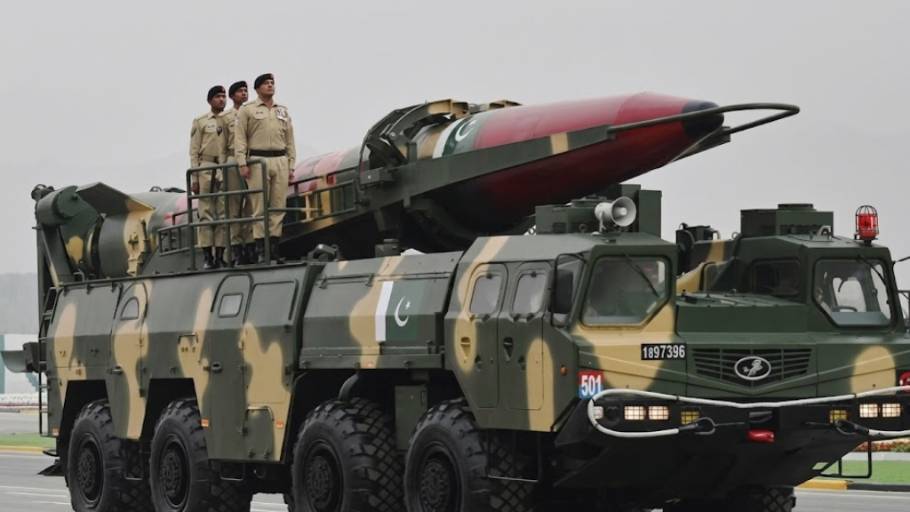
Missile development accelerated through the 1990s. Ghaznavi, Shaheen, Ghauri missile families. Need to deliver the weapons that officially didn’t exist.
By 1998 we were ready to go public. We just needed a reason.
May 1998 and the Decision
India tested in May 1998. Five nuclear tests at Pokhran on May 11 and 13. Public declaration that they were a nuclear state.
Pakistan had a choice. Test or stay ambiguous. The pressure from both sides was extreme.
Clinton called Nawaz Sharif personally. American envoys flew to Pakistan. Massive incentive packages were offered for restraint. Sanctions threats made. The international pressure to not test was probably the most intense Pakistan had ever faced.
Domestic pressure was the opposite. Pakistani public went absolutely berserk demanding response. Opposition parties demanded tests. Religious parties demanded tests. The military wanted tests. The scientific establishment wanted tests. Sharif’s own party was demanding tests.
There’s a famous story that during the deliberation, Sharif asked someone what would happen if he didn’t test. The answer was that he’d be politically finished. The Indian tests had created a situation where any leader who didn’t respond would be seen as betraying Pakistan.
So Sharif gave the order. Tests would happen at Chagai Hills in Balochistan. Preparation had been ready for years.
May 28, 1998. Five tests at Chagai-I. Yields ranged from low-kiloton to bigger devices. Pakistan was officially a nuclear weapons state.
May 30, 1998. One more test at Chagai-II. Total of six.
The reactions were predictable. Sanctions piled on. Economic stress was immediate. But strategically we’d achieved parity with India. Conventional Indian military attack against Pakistan became unthinkable.
May 28 became Youm-e-Takbeer. National celebration every year since.
The A.Q. Khan Disaster
Then in 2003-2004, the whole thing came back to bite us. International intelligence agencies had been tracking A.Q. Khan’s activities for years. Now they revealed what they’d found.
A.Q. Khan had been running a private nuclear proliferation network. Selling nuclear technology, centrifuge designs, and possibly weapons designs to Libya, Iran, and North Korea. The largest illicit nuclear proliferation operation ever discovered.
In February 2004, A.Q. Khan went on TV and confessed. He took complete personal responsibility. Said he’d done it without government knowledge. Got placed under house arrest.
The claim that the government didn’t know? Most international experts find that hard to believe. A network operating at that scale for over a decade, transferring sensitive nuclear technology to multiple countries, using Pakistani logistics and resources. Did absolutely nobody in Pakistani intelligence or military notice?
Either Pakistani intelligence was incompetent on a massive scale, or they tolerated it deliberately, or some combination. The official Pakistani position has stayed firmly that Khan acted alone.
Musharraf eventually pardoned him. He lived under restrictions until dying from COVID in October 2021.
The scandal damaged Pakistan’s international standing badly. Other countries pointed at it for years as reason to limit nuclear cooperation with us. It still affects how the international community thinks about Pakistani nuclear management.
The Doctrine We Actually Have
So what’s Pakistan’s nuclear doctrine actually look like? Several things matter.
The Strategic Plans Division (SPD) runs strategic forces. Set up in 2000. Lieutenant General Khalid Kidwai shaped doctrinal thinking for years.
The National Command Authority (NCA) makes nuclear decisions. Prime Minister chairs it. Senior military and civilian officials are members. In theory civilian control with military input.
The official doctrine is “Credible Minimum Deterrence.” Enough capability to deter India without unlimited spending.
The key differences from India:
- We have first-use option. India has stated No-First-Use policy. We don’t. If India invades conventionally and threatens Pakistan’s survival, we reserve the right to go nuclear first.
- We have tactical nuclear weapons. The Nasr short-range missile was specifically designed to deter Indian Cold Start doctrine of rapid conventional attacks. India officially doesn’t have battlefield nukes.
- Civilian command in theory. Military input is central. The relationship between civilian and military control of nuclear weapons in Pakistan is more military-influenced than most democracies want.
Where We Are Now
Pakistan’s nuclear program history through 2026 keeps evolving. Modernization continues.
Current estimates suggest 170-200 warheads. Similar to India. Bigger than some major powers’ arsenals.
Delivery systems span everything:
- F-16s and probably JF-17s with nuclear capability
- Ballistic missiles from Nasr (short-range) to Shaheen-III (2,750 km range)
- Babur cruise missiles ground and air launched
- Babur-III submarine-launched cruise missile for sea-based deterrence
The full nuclear triad is emerging. Land, air, and sea delivery. Makes any potential adversary planning much more complicated.
Ababeel MIRV-capable missile tested in 2017. Designed to overcome ballistic missile defense. Counter to Indian ballistic missile defense systems.
The May 2025 conflict with India happened entirely in nuclear shadow. Both sides restrained conventional operations because of escalation fears. The deterrence logic we built from 1972 to 1998 actually worked in 2025.
The Honest Take
Look, Pakistan’s nuclear program history is complicated. It involves genuine scientific achievement. It also involves technology theft and proliferation scandals. It includes strategic success and international embarrassment.
What it actually achieved:
- Real deterrence against Indian conventional military superiority
- Survival of the country in strategic terms after 1971 trauma
- Civilian nuclear power that provides actual electricity
- Defense industry capability that wouldn’t exist otherwise
What it cost us:
- The A.Q. Khan proliferation scandal that damaged international standing for decades
- Permanent international suspicion about Pakistani nuclear management
- Sanctions and technology restrictions that continue
- Resources spent on arms race that could have built schools and hospitals
- Position outside major international nuclear governance frameworks
Strategic reality? Nuclear weapons changed Pakistan’s position fundamentally. We can’t be conventionally defeated and occupied anymore. India knows it. We know it. The whole regional security situation got restructured around this fact.
Whether the cost was worth it is genuinely debatable. Different Pakistanis would give different honest answers. But the program exists. It works. It deters. It continues being central to national security.
Final Thoughts
Pakistan’s nuclear program history is genuinely one of the most consequential things that happened in our country since independence. From the 1972 Multan meeting after the 1971 disaster, through the 1980s secret development, through the 1998 tests that announced ourselves to the world, through the A.Q. Khan disaster, through continuing modernization in 2026.
For Pakistanis, knowing the actual history matters more than just celebrating the achievement. The decisions that built this program continue affecting our foreign policy. The institutional structures continue evolving. The strategic logic continues operating in conflicts like May 2025.
The honest version isn’t pure triumph. It’s not pure failure either. It’s a real story about a country deciding that strategic survival required nuclear weapons after conventional defeat, then spending 26 years building that capability through every kind of difficulty, then announcing itself to the world, then dealing with both the benefits and the complications that followed.
We have the bomb. We deter India. We also pay ongoing costs for the way we got the bomb and what some Pakistanis did with that capability. Both are true.
That’s the actual story of Pakistan’s nuclear program history. Born from defeat, built in secret, declared in 1998, scandalized in 2004, modernized continuously, and continuing to define our strategic position in 2026.
Abdul Sattar Edhi: The Real Story of Pakistan’s Greatest Humanitarian



Comments